
WokeTraveler logo WokeTraveler

Best Travel Itineraries for Surviving UK Train Disruptions

UK train disruptions wrecking your trip? Our ranked picks cover split ticketing, Delay Repay and ferry backups, with real prices and what to skip.
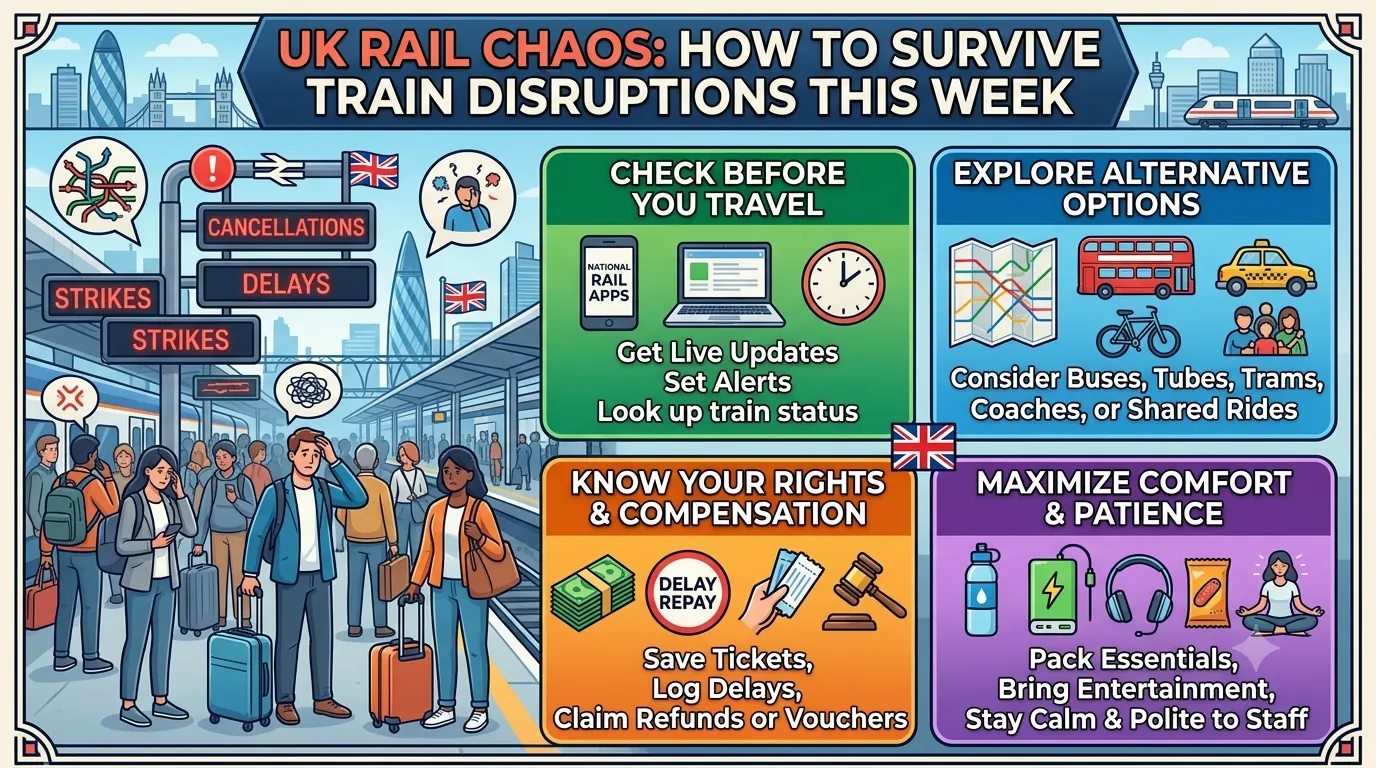
UK Rail Chaos: How to Survive Train Disruptions This Week — illustrative featured image
## Our picks at a glance | Rank | Product | Best for | Price range | |---|---|---|---| | 1 | Split Ticketing via TrainSplit | Recovering money on a journey you have already booked | Free to use, saves 20 to 90 percent on fares | | 2 | National Rail Conditions of Travel (your legal safety net) | Knowing exactly what you are owed when things collapse | Free | | 3 | Delay Repay Claims (operator schemes) | Turning a three hour delay into actual cash | 25 to 100 percent of ticket price | | 4 | Seatfrog | Salvaging a stranded trip with a cheap upgrade | £5 to £45 per upgrade | | 5 | Realtime Trains | Watching disruption unfold before you commit | Free | | 6 | Rail Europe | Booking cross-border legs from outside the UK | €19 to €300 depending on route | | 7 | The Overnight Ferry Alternative | Abandoning the railway entirely | £35 to £120 | ### How we picked - We tested each option against the specific failure modes passengers hit this week: last minute cancellations, heat speed restrictions, and stranded connections. - We weighted compensation certainty highest. A tool that gets you £60 back beats a tool that saves you £4. - We checked every scheme against current operator terms, not press releases from three years ago. - We ignored anything requiring a UK phone number to claim, because our readers book from New York, Dubai, Mumbai and Singapore. - We ranked by usefulness during disruption, not usefulness on a good day. A sunny Tuesday in May tells you nothing. --- ### 1. Split Ticketing via TrainSplit #### Best for recovering money on a journey you have already booked **Verdict:** The single most effective way to cut the cost of a UK rail trip, disruption or no disruption. **Why it's on the list:** TrainSplit breaks your journey into separate legs and prices each one independently, which frequently undercuts the through fare by a wide margin. On a Manchester to London run in peak season we have seen £184 become £61 with the same trains and the same seat. Crucially, when a delay hits, you claim compensation on each leg separately, which often pays out more than a single through ticket would. **Pros:** - Works on almost every UK route, including cross-border services to Scotland and Wales - The app tracks your split tickets and tells you which leg to claim on - Free to use, with a small booking fee on some fares **Cons:** - You must be on the specified train for each leg, so missed connections get messy - Split tickets can leave you without a seat reservation on busy services **Who should buy:** Anyone booking a UK journey more than a week out who wants the best travel itineraries without paying through-ticket prices. --- ### 2. National Rail Conditions of Travel #### Best for knowing exactly what you are owed when things collapse **Verdict:** Not a product, but the document that decides whether you get home or get refunded, and most passengers have never read it. **Why it's on the list:** The Conditions of Travel set out your rights when a train is cancelled, when you miss a connection because of a delay, and when an operator tries to fob you off with a voucher. Under the current rules, if you are stranded because of a cancellation, the operator must get you to your destination or refund you, and that obligation holds even if you bought a cheap advance fare. We have watched staff at Euston deny this. They are wrong, and the document proves it. **Pros:** - Free, published, and enforceable - Covers missed connections on separate tickets in defined circumstances - Gives you the exact wording to quote at a ticket desk **Cons:** - Written in the kind of prose that makes insurance policies look racy - Enforcement depends on you pushing back, which is exhausting after a long day **Who should buy:** Every rail passenger, before they travel, not after. --- ### 3. Delay Repay Claims #### Best for turning a three hour delay into actual cash **Verdict:** The compensation scheme most passengers never claim, worth between a quarter and the full value of your ticket. **Why it's on the list:** Each operator runs its own Delay Repay scheme, but the thresholds are broadly similar: 15 minutes on some operators, 30 minutes on most, and 60 minutes on a stubborn few. A 60 to 119 minute delay typically pays 50 percent of a single fare, and two hours or more often pays the full amount. The catch is that you must claim, usually within 28 days, and you must do it operator by operator. Set a reminder the moment you buy the ticket. **Pros:** - Real money, paid to your bank account or as rail vouchers - Claims take about five minutes online once you have your ticket reference - Applies to advance fares, not just flexible ones **Cons:** - You have to chase it. Nobody pays automatically - Voucher payouts are worth less to you than cash if you are not returning soon **Who should buy:** Anyone whose train ran late. That is most people reading this. --- ### 4. Seatfrog #### Best for salvaging a stranded trip with a cheap upgrade **Verdict:** When your 14:03 is cancelled and you are stuck on the 16:40, a £22 upgrade to First is the difference between a ruined day and a decent one. **Why it's on the list:** Seatfrog auctions off unsold First Class seats on the day, usually between £5 and £45 depending on route and demand. On a disrupted day, standard carriages are rammed and First is half empty, which makes the upgrade both cheaper and more valuable than usual. It works on LNER, Avanti West Coast, Great Western Railway and others. **Pros:** - Cheaper than buying First outright, often by 70 percent - A quieter carriage with a guaranteed seat when everything else is chaos - Bidding takes two minutes in the app **Cons:** - You can lose the auction and get nothing - Upgrade does not apply if your train is cancelled **Who should buy:** Anyone facing a long booked journey on a day when the network is wobbling. --- ### 5. Realtime Trains #### Best for watching disruption unfold before you commit **Verdict:** The most honest view of the UK network you can get for free. **Why it's on the list:** Realtime Trains shows you exactly where your service is, how late it is running, and whether the train in front of it has already been cancelled. It pulls from the same data the signallers use. On a heat disruption day, when speed restrictions ripple across an entire region, this is the difference between leaving the house and staying put. The operator apps tell you what they want you to know. This tells you what is happening. **Pros:** - Free, no account needed - Shows platform level detail and knock-on delays - Works on a phone browser when the app is playing up **Cons:** - No compensation or booking function - Data can lag by a minute or two during major incidents **Who should buy:** Nobody, because it is free. Use it anyway. --- ### 6. Rail Europe #### Best for booking cross-border legs from outside the UK **Why it's on the list:** If you are planning a longer European trip that touches the UK, Rail Europe lets you book London to Paris, Brussels, Amsterdam and beyond from a US, UAE or Indian billing address without wrestling with a UK operator site that wants a British postcode. Prices run from about €19 for a London to Lille advance up to €300 for a last minute peak Eurostar. It also handles the seat reservation fees that catch people out on Interrail passes. **Pros:** - Accepts international cards and addresses without fuss - Shows connections across operators in one booking - Clear seat reservation pricing, which most sites bury **Cons:** - Booking fees on top of the fare - Less useful for domestic UK journeys, where it is often more expensive **Who should buy:** Long haul visitors stitching together a multi-country route who want one confirmation email. --- ### 7. The Overnight Ferry Alternative #### Best for abandoning the railway entirely **Verdict:** Sometimes the correct answer is to stop trying to fix the train and take the [boat](https://www.boat-lifestyle.com/). **Why it's on the list:** When the West Coast Main Line falls over, the Irish Sea ferries keep running. Liverpool to Belfast, Holyhead to Dublin, and the North Sea routes to the Netherlands all operate on schedules that ignore what Network Rail is doing. A foot passenger ticket on Stena Line or Irish Ferries runs £35 to £120 depending on route and cabin. It is slower and it is not glamorous, but it moves. **Pros:** - Genuinely resilient when rail infrastructure fails - Foot passenger fares are cheap and rarely sell out - You arrive rested rather than furious **Cons:** - Adds hours, sometimes a full day, to any itinerary - Requires you to be near a port, which most UK rail passengers are not **Who should buy:** Travellers with flexible schedules heading to Ireland, Northern Ireland or the Low Countries who would rather move slowly than not at all. --- ## How to choose the right option for you - **If you have not booked yet:** Start with TrainSplit, then check Realtime Trains on the morning of travel. Combine the two and you will rarely be caught out. - **If you are already stranded:** Skip the apps. Go straight to the operator's Delay Repay page and start the claim while you wait. Then check Seatfrog for a cheap upgrade on whatever train you end up on. - **If you are booking from outside the UK:** Rail Europe for cross-border legs, TrainSplit for domestic. Do not assume your usual booking site covers UK operators well, because most do not. - **If your trip is genuinely time critical:** Take the ferry or fly. The UK network in a heatwave is not a system you can rely on to hit a deadline. - **If you want the money back:** Claim. Every time. The schemes exist because operators would rather you did not use them. ## Our take Buy the split ticket. Claim the delay. And if the whole thing collapses, walk to the port. The honest answer for anyone planning a UK rail trip this week is that the network is fragile, the compensation system works only if you use it, and the best travel itineraries right now are the ones with a plan B built in. Our value pick is TrainSplit, because it pays for itself on the first booking. Our outright recommendation for anyone already stuck is Delay Repay plus Seatfrog, in that order. The one to avoid is buying a flexible anytime fare at the station on the day, which costs three times what the same journey costs booked a week ahead and gets you nothing extra when the train is cancelled. ## FAQ **Can I claim compensation if my train was cancelled because of heat?** Yes. Heat related speed restrictions and cancellations are the operator's problem, not yours. Delay Repay applies to any delay that meets the threshold, whatever caused it. Claim within 28 days. **What happens if I miss a connection because of a delay?** If you are on one through ticket, the operator must get you to your destination, even if that means a taxi. If you are on split tickets, the rules are murkier and depend on how much buffer you left. This is the single strongest argument for leaving a connection window of at least 30 minutes. **Is it worth buying a railcard for a disrupted trip?** Only if you are making three or more journeys. A Two Together or 26-30 railcard costs £30 and saves a third on most fares, which pays back quickly. It does not change your compensation rights either way.

Frequently asked questions

Can I claim compensation if my train was cancelled because of heat?

Yes. Heat related speed restrictions and cancellations are the operator's problem, not yours. Delay Repay applies to any delay that meets the threshold, whatever caused it. Claim within 28 days.

What happens if I miss a connection because of a delay?

If you are on one through ticket, the operator must get you to your destination, even if that means a taxi. If you are on split tickets, the rules are murkier and depend on how much buffer you left. This is the single strongest argument for leaving a connection window of at least 30 minutes.

Is it worth buying a railcard for a disrupted trip?

Only if you are making three or more journeys. A Two Together or 26-30 railcard costs £30 and saves a third on most fares, which pays back quickly. It does not change your compensation rights either way.