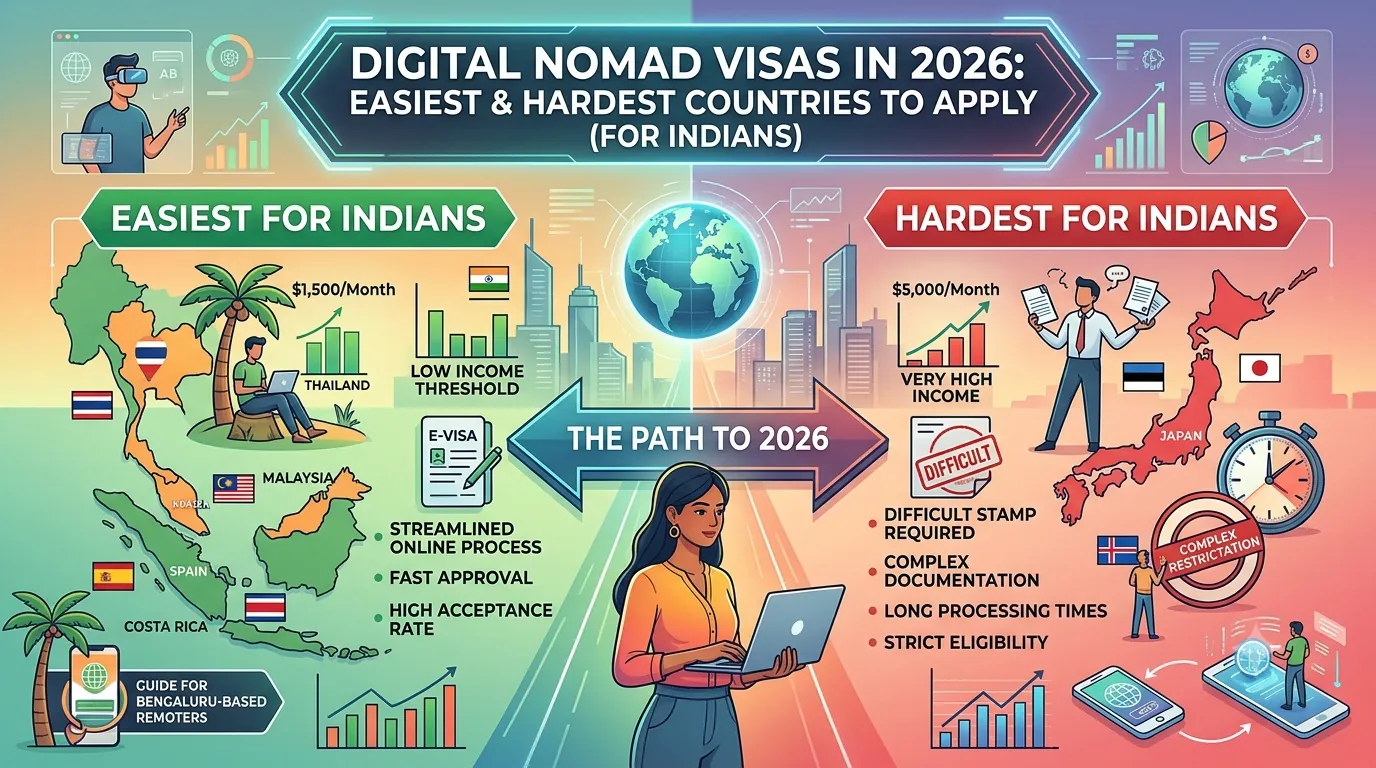
Digital Nomad Visas 2026: Easiest and Hardest Countries
We ranked digital nomad visas by cost, income threshold and paperwork in 2026. Estonia wins, Georgia is the value pick, Greece is the one to avoid.
# Digital Nomad Visas in 2026: Easiest and Hardest Countries to Apply
A reader named Tom wrote to us last month from a coworking space in Lisbon, furious. He had spent eleven weeks assembling bank statements, apostilled police certificates and a notarised lease for a Portuguese [digital nomad](/blog/the-digital-nomad-s-guide-to-avoiding-vacation-rental-nightmares-how-to-choose-a) visa, only to discover his freelance income, paid in pounds from three different clients, did not clear the threshold in the way the consulate wanted it counted. Eleven weeks. He is now applying to Estonia instead, which took him nine days to prepare.
Tom's problem is the one we keep hearing in 2026: the visa exists, the paperwork does not fit. So we ranked the major schemes by what they actually cost a remote worker holding a UK, EU or US passport, with notes for readers applying from the Gulf, India and South East Asia. Here is the framing that matters first, though. If you are weighing a long southern-hemisphere stint, the **best time to visit australia and new zealand** is their summer (December to February), and the visa timelines below should be planned backwards from that, not forwards.
## How we ranked these
We scored each scheme on four things, in this order:
1. **Application friction.** Documents required, whether you can apply in-country, and how long the decision takes in practice.
2. **Income threshold.** The number, and whether it is assessed monthly or annually (this trips up freelancers constantly).
3. **Total cost year one.** Visa fee, plus mandatory insurance and any local registration.
4. **Route to something longer.** Whether the visa renews, converts to residency, or dead-ends.
We deliberately did not rank on tax friendliness. That is a separate article and a separate accountant.
## The easiest five
### 1. Estonia (best overall)
Estonia's scheme remains the one we recommend to almost everyone first. The income threshold sits around **EUR 4,500 gross per month**, you apply at an embassy or consulate, and the decision typically lands within 30 days. The visa fee is roughly **EUR 100 to EUR 120** depending on where you file. Renewal is straightforward and the country has spent a decade building infrastructure around remote work.
**Skip it if** you want warm weather in February. Tallinn is beautiful and freezing.
### 2. Georgia (the value pick)
Georgia is the quiet winner of 2026. Citizens of the UK, EU, US and dozens of other countries can stay **365 days visa-free**, then extend. There is no income threshold for the visa-free route at all, and the "Remotely from Georgia" programme, where it applies, asks for about **USD 2,000 per month**. Living costs in Tbilisi run perhaps 40 percent below Lisbon.
**Skip it if** you need a formal residency card for banking or Schengen access. The visa-free route is generous but thin on paperwork you can wave at a landlord.
### 3. Portugal (best for families, worst for freelancers)
The D8 visa is genuinely good: five-year path to residency, family included, and a threshold of **EUR 3,480 per month** (four times the minimum wage). The fee is around **EUR 180**. But Tom's experience is the norm, not the exception. Consulates in London and Washington are slow, documentation is heavy, and the income test is assessed in a way that punishes multi-client freelancers.
**Skip it if** your income is irregular or you cannot wait three months.
### 4. Croatia
Croatia asks for roughly **EUR 2,540 per month** (about 2.5 times the average salary) and charges around **EUR 100** for the application. Decisions come in 15 to 30 days. It is a genuinely pleasant place to spend a [shoulder season](/blog/fall-travel-deals-where-to-go-for-up-to-30-cheaper-than-summer), and Split in October is one of the great underrated working months in Europe.
**Skip it if** you need to renew more than once; the path beyond the first year is murky.
### 5. Spain
Spain's threshold is the highest of the easy group at about **EUR 2,850 per month**, with a fee near **EUR 80**. The catch is consular backlog. Madrid has improved, but London and New York applicants report two to three months routinely.
**Skip it if** you are applying from the US and need to move within six weeks.
## The hardest three
### UAE (Dubai)
The remote work visa costs about **AED 2,000 (roughly USD 545)** and requires **USD 3,500 per month**. On paper, fine. In practice, the process assumes a local sponsor relationship and the insurance requirement is expensive. For Gulf-based readers, it is often easier to stay on a tourist visa and leave every 60 days.
### Japan
Japan's [digital nomad](/blog/the-7-best-sustainable-travel-destinations-for-eco-conscious-nomads) visa requires **JPY 10 million annually (about USD 67,000)** and does not renew. It is a six-month experiment, not a base. Wonderful country, wrong visa.
### Greece
Greece asks for **EUR 3,500 per month** net and the tax treatment for remote workers has been in flux. We would wait a year before committing.
## Our take
**The one to buy:** Estonia. Fast, cheap, clear.
**The value pick:** Georgia. A year for the price of a flight.
**The one to avoid in 2026:** Greece, until the tax rules settle.
For readers in India, South East Asia and the Gulf, the calculation shifts: Estonia and Croatia are the cleanest consular experiences from Delhi, Singapore and Dubai respectively. For US and UK readers heading south for summer, remember the **best time to visit australia and new zealand** is December to February, so file your visa application by August at the latest.
## FAQ
**How much money do I need for a digital nomad visa?**
Most schemes want **EUR 2,500 to EUR 4,500 per month** of provable income. Georgia is the outlier at effectively zero.
**Can I apply from inside the country?**
Estonia and Croatia allow some in-country applications. Portugal and Spain generally require you to apply from your home consulate.
**Which is fastest?**
Georgia (no application), then Estonia (about 30 days), then Croatia (15 to 30 days).
Frequently asked questions
How much money do I need for a digital nomad visa?
Most schemes want **EUR 2,500 to EUR 4,500 per month** of provable income. Georgia is the outlier at effectively zero.
Can I apply from inside the country?
Estonia and Croatia allow some in-country applications. Portugal and Spain generally require you to apply from your home consulate.
Which is fastest?
Georgia (no application), then Estonia (about 30 days), then Croatia (15 to 30 days).
 WokeTraveler